Operations & Maintenance
Day-to-day operations procedures, maintenance schedules, performance monitoring, and continuous improvement practices for the network security audit and digital forensics platform.
12.1 SOC Operations Overview
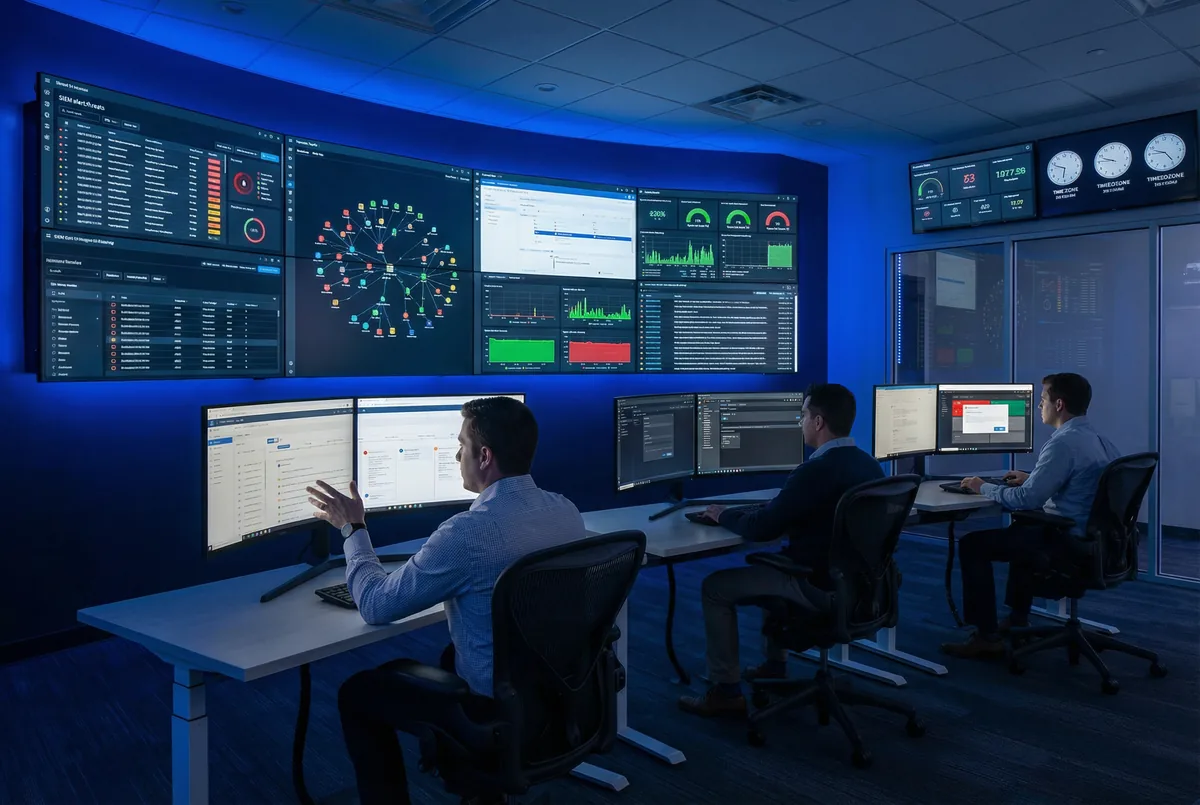
Effective operations of the audit and forensics platform requires a structured Security Operations Center (SOC) workflow that integrates alert triage, incident investigation, forensic case management, and platform health monitoring into a cohesive daily operating rhythm. The SOC operations scene below illustrates the target state: three analysts working in parallel across the SIEM alert console, forensic investigation workbench, and platform health dashboard, supported by a large-format video wall for situational awareness.
12.2 Daily Operations Procedures
The daily operations cycle for the audit and forensics platform follows a structured shift handover and monitoring cadence. The following table defines the key daily operations tasks, their frequency, responsible role, and the tools used. All daily operations activities must be logged in the platform's operations journal for audit trail purposes.
| Task | Frequency | Responsible Role | Tool / Console | Escalation Threshold |
|---|---|---|---|---|
| SIEM alert queue review and triage | Continuous (24×7) | SOC Analyst L1 | SIEM alert console | P1/P2 alerts → immediate escalation to L2 |
| Platform health dashboard review | Every 4 hours | SOC Analyst L1 | Monitoring dashboard | Any component <99% availability → escalate to platform admin |
| Log collection completeness check | Daily (08:00) | SOC Analyst L2 | SIEM data source monitor | Any source silent >1 hour → investigate and escalate |
| Evidence vault integrity verification | Daily (automated) | Platform (automated) | Evidence vault health check | Any hash chain failure → immediate P1 escalation |
| Threat intelligence feed freshness check | Daily (08:00) | SOC Analyst L2 | TI platform console | Any feed stale >4 hours → manual refresh or escalate |
| Shift handover briefing | Per shift change | SOC Shift Lead | Case management system | All open P1/P2 cases must be briefed to incoming shift |
| Forensic case status review | Daily (09:00) | SOC Analyst L3 / Forensic Analyst | Case management system | Cases approaching SLA deadline → escalate to SOC Manager |
| Storage capacity check | Daily (automated) | Platform (automated) | Monitoring dashboard | Any storage >80% → alert platform admin for capacity planning |
12.3 Maintenance Schedule
Planned maintenance activities must be scheduled during approved maintenance windows to minimize operational impact. The following maintenance schedule defines the recommended cadence for each category of maintenance activity. All maintenance activities must be documented in the change management system and approved before execution.
| Maintenance Activity | Cadence | Estimated Duration | Impact | Rollback Plan |
|---|---|---|---|---|
| SIEM detection rule updates | Weekly | 2 hours | None (hot update) | Revert to previous rule set via version control |
| Platform software patch (minor) | Monthly | 4 hours | Rolling restart; no downtime | Rollback to previous version via package manager |
| Platform software upgrade (major) | Quarterly | 8 hours | Planned maintenance window; brief downtime | Snapshot-based rollback; 4-hour RTO |
| OS security patching | Monthly | 2 hours per node | Rolling restart; no downtime | Reboot to previous kernel |
| Certificate renewal | Annually (automated) | 1 hour | None (automated via SCEP) | Manual certificate re-issue; 2-hour RTO |
| Backup and DR test | Quarterly | 4 hours | DR site only; no production impact | N/A (test environment) |
| Storage capacity expansion | As needed (>70% utilization) | 4–8 hours | Brief storage service interruption | Remove new storage; revert to previous configuration |
| Annual security review and penetration test | Annually | 5 days | Read-only testing; no production impact | N/A (read-only) |
12.4 Key Performance Indicators
Platform operations effectiveness is measured through a set of Key Performance Indicators (KPIs) that are reviewed monthly by the SOC Manager and reported quarterly to the CISO. The following KPIs cover platform health, detection effectiveness, and forensic response performance. Trend analysis over rolling 12-month periods is required to identify performance degradation early.
| KPI | Target | Warning Threshold | Critical Threshold | Reporting Frequency |
|---|---|---|---|---|
| Platform Availability | ≥99.99% | <99.9% | <99.5% | Monthly |
| Log Collection Completeness | ≥99.5% of expected sources reporting | <98% | <95% | Daily / Monthly trend |
| Mean Time to Detect (MTTD) | ≤15 minutes | >30 minutes | >60 minutes | Monthly |
| Mean Time to Respond (MTTR) | ≤5 minutes (alert to case) | >15 minutes | >30 minutes | Monthly |
| False Positive Rate | ≤5% | >10% | >20% | Monthly |
| Evidence Integrity Pass Rate | 100% | N/A | Any failure | Daily / Monthly |
| Forensic Case SLA Compliance | ≥95% of cases closed within SLA | <90% | <80% | Monthly |
| Compliance Report Generation | 100% on-time delivery | Any late delivery | Any missed delivery | Per compliance cycle |